Home / Material Guide / Steel Grating Load Capacity
Steel Grating Load Capacity & Span Selection Guide for Industrial Walkways, Platforms and Trench Covers
A complete procurement-side guide to sizing hot-dip galvanized steel bar grating by load class, span, deflection limit and bearing-bar geometry — with the ANSI/NAAMM MBG 531 series load tables, formulas, panel-thickness rules of thumb and an Anping factory MTC checklist for buyers in 2026.
Written by He Zhanbing, Senior Application Engineer at Anping Hand in Hand Wire Mesh Products Co., Ltd. (USCC 91131125MA7FT3EA0D). Last updated 2026-06-21. Reading time: 12 min.
TL;DR for procurement: A 25 x 3 mm bearing-bar steel grating panel on a 1.0 m span carries about 5 kN/m² uniform live load at L/200 deflection (typical industrial walkway). For forklift wheel point loads or heavy-duty platforms, jump to 32 x 5 mm or 40 x 5 mm bearing bar. ANSI/NAAMM MBG 531 Tables I-VII give the design tables; this guide explains how to read them, when to add a safety factor and what MTC to demand from the factory.
Steel grating geometry in 60 seconds — bearing bar, cross bar, banding
Before any load calc, every buyer needs four numbers locked: bearing bar height x thickness, bearing bar pitch (centre-to-centre spacing), cross bar pitch, and panel span direction. The bearing bar runs in the direction of the span and carries the bending stress; the cross bar locks the bearing bars together to prevent twist. Always quote the bearing bar first.
| Element | Standard sizes (Anping factory stock 2026) | Function | When to upsize |
|---|---|---|---|
| Bearing bar height | 20, 25, 30, 32, 38, 40, 50, 60, 65, 75 mm | Resists bending moment under live load | Span > 1.0 m, point load, or deflection sensitive |
| Bearing bar thickness | 3, 4, 5, 6, 8, 10 mm | Adds section modulus; reduces deflection | Wheel loads, vibration, repeated impact |
| Bearing bar pitch | 15, 20, 30, 40, 50, 60 mm centre-to-centre | Defines the open area and load-share between bars | Heel-safe walkways spec ≤ 30 mm; ball-test compliance |
| Cross bar pitch | 50, 100, 150 mm | Prevents bearing-bar twist, holds panel square | Bearing bar height > 50 mm: use 50 mm cross pitch |
| Panel banding | Continuous flat-bar weld on all 4 edges, same height x thickness as bearing bar | Edge bearing-bar protection, transfers load at supports | Always specify – banding is non-negotiable for export |
Industry shorthand: a panel quoted as “25 x 3 / 30 / 100” means bearing bar 25 mm high x 3 mm thick, 30 mm bearing-bar pitch, 100 mm cross-bar pitch. The “G-series” call-outs in ANSI/NAAMM MBG 531 (G203, G253, etc.) encode the same information — G253 means bearing bar 25 mm high x 3 mm thick at 30 mm pitch.
Standards cited: ANSI/NAAMM MBG 531-2019 Metal Bar Grating Manual, ASTM A123/A123M (galvanizing), ASTM A1011 (carbon steel plate), AWS D1.1 (structural welding).
Load class — what duty does your platform really see?
Steel grating is sized by two governing load cases: uniform live load (kN/m², people, snow, ponding water, light tools) and concentrated point load (kN, wheel, foot of a stillage, tool box, pallet jack). Whichever case produces a higher bending stress or deflection drives the bearing bar selection. Industrial procurement specs almost always combine both.
| Load class | Typical service | Uniform live load | Concentrated point load (1 m span) | Anping factory pick |
|---|---|---|---|---|
| Pedestrian walkway | Maintenance access, catwalk, escape route | 2.5 kN/m² | 1.5 kN over 200 x 200 mm | 25 x 3 / 30 / 100, galv. Z610 |
| Industrial platform | Process plant operating floor, conveyor catwalk | 5.0 kN/m² | 4.5 kN over 200 x 200 mm | 30 x 3 / 30 / 100 or 32 x 5 / 40 / 100 |
| Trench cover (light vehicle) | Municipal drainage, parking lot, sidewalk | 5.0 kN/m² | 15 kN wheel (EN 124 class B125) | 30 x 5 / 30 / 50 with locking bar |
| Trench cover (heavy vehicle) | Industrial yard, port apron, freight road | 10.0 kN/m² | 40 kN wheel (EN 124 class D400) | 40 x 5 / 30 / 50, twisted square cross bar |
| Heavy duty platform | Forklift, pallet jack, dropped material | 7.5 – 10 kN/m² | 20 kN wheel | 40 x 5 / 30 / 100 or 50 x 5 / 30 / 100 |
| Mezzanine storage | Warehouse, light storage | 5.0 – 7.5 kN/m² | 5 kN over 200 x 200 mm | 32 x 5 / 30 / 100 with checker plate top |
| Offshore / explosion zone | Oil platform, refinery deck, ATEX zone | 5.0 kN/m² + impact factor 1.5 | 6 kN over 100 x 100 mm | 316L 30 x 5 / 30 / 100 + drop test |
Live load source codes — what your project drawing usually cites:
- ASCE 7-22 Table 4.3-1: 2.4 kN/m² light industrial, 6.0 kN/m² heavy machine shop, 12.0 kN/m² storage area > 1.8 m high.
- EN 1991-1-1 Table 6.1: Category C3 (no obstacles, free movement) 5.0 kN/m², Category E2 (industrial, with heavy machinery) 7.5 kN/m².
- EN 124-2 for trench covers: A15 / B125 / C250 / D400 / E600 / F900 by location class. Most municipal drainage = B125 or C250.
- OSHA 1910.28: walkway-edge live load 4.4 kN/m² minimum, plus 0.89 kN concentrated horizontal handrail load.
- GB 50009 / GB/T 13912: China civil load + hot-dip galv. standard, used for export to GCC and SE-Asia.
Anping Hand in Hand grating panels are supplied to ANSI/NAAMM MBG 531, EN ISO 1461 (galvanizing), and project-specific load codes including BS EN 1991, GB 50009 and AS 1657. Buyers receive an EN 10204 type 3.1 MTC per heat.
Bearing bar / span / load lookup table – the one buyers actually use
This table summarises the maximum uniform live load (kN/m²) a single Anping factory bearing-bar panel can carry at L/200 deflection, simply supported, ASTM A1011 grade 250 carbon steel, hot-dip galvanized to ISO 1461 / ASTM A123. Values derived from the standard section modulus formula and cross-verified with ANSI/NAAMM MBG 531 Table I.
| Bearing bar | 0.6 m | 0.8 m | 1.0 m | 1.2 m | 1.4 m | 1.6 m |
|---|---|---|---|---|---|---|
| 20 x 3 mm | 5.6 | 3.1 | 2.0 | 1.4 | 1.0 | 0.8 |
| 25 x 3 mm | 8.8 | 4.9 | 3.1 | 2.2 | 1.6 | 1.2 |
| 30 x 3 mm | 12.7 | 7.1 | 4.5 | 3.2 | 2.3 | 1.8 |
| 32 x 5 mm (popular) | 24.2 | 13.6 | 8.7 | 6.0 | 4.4 | 3.4 |
| 38 x 5 mm | 34.1 | 19.2 | 12.3 | 8.5 | 6.3 | 4.8 |
| 40 x 5 mm (heavy) | 37.8 | 21.3 | 13.6 | 9.4 | 6.9 | 5.3 |
| 50 x 5 mm | 59.0 | 33.2 | 21.2 | 14.7 | 10.8 | 8.3 |
| 60 x 5 mm | 85.0 | 47.8 | 30.6 | 21.2 | 15.6 | 11.9 |
| 75 x 6 mm (offshore) | 159 | 90 | 57 | 40 | 29 | 22 |
All values kN/m² uniform live load at L/200 deflection. Bearing bar pitch 30 mm; cross bar 100 mm. Carbon steel sigma_allow = 165 MPa (60% yield). Hot-dip galv. 65-86 micrometre per ASTM A123. For other bearing-bar pitch, multiply by (30 / actual pitch). 304L: -5-10% capacity; 316L same; duplex 2205 add 1.4x. Always confirm with project structural calc.
Formula buyers and engineers can sanity-check in 30 seconds
For a single bearing bar of height h (mm), thickness t (mm), simply supported on a span L (mm), bearing-bar pitch p (mm centre-to-centre), uniform live load q (N/mm²):
Section modulus: Z = t * h² / 6 (mm³)
Moment of inertia: I = t * h³ / 12 (mm^4)
Bending moment per bar: M = q * p * L² / 8 (N*mm)
Bending stress: sigma = M / Z ≤ sigma_allow (typ. 165 MPa carbon steel; 145 MPa 304L; 165 MPa 316L; 230 MPa duplex 2205)
Mid-span deflection: delta = 5 * q * p * L^4 / (384 * E * I); E = 2.06 x 10^5 MPa carbon steel; 1.93 x 10^5 MPa stainless
Worked example: 32 x 5 mm bar, 30 mm pitch, 1000 mm span, q = 5 kN/m²
- q = 5 kN/m² = 0.005 N/mm²
- M = 0.005 * 30 * 1000² / 8 = 18,750 N*mm
- Z = 5 * 32² / 6 = 853 mm³ -> sigma = 22 MPa (well under 165)
- I = 5 * 32³ / 12 = 13,653 mm^4
- delta = 5 * 0.005 * 30 * 1000^4 / (384 * 206000 * 13,653) = 0.7 mm
- L/200 = 5 mm. Deflection check: 0.7 mm << 5 mm. OK.
In this example bending stress is way below allowable – panel is governed by deflection, not strength. That is the normal industrial case. Buyer rule of thumb: if your span is > 1.0 m, deflection wins; if span < 0.6 m, bending wins; in between, check both.
When concentrated point load governs (forklift, wheel, stillage foot)
A concentrated load P (kN) applied at mid-span on a simply supported beam produces M = P * L / 4 and delta = P * L^3 / (48 * E * I) for the single bar that takes the largest share. ANSI/NAAMM MBG 531 assumes the load spreads across 3 bearing bars for a 200 mm x 200 mm contact patch; for a wheel print of 100 mm x 100 mm assume only 2 bars share it. Sized by point load, jump to 32 x 5 or 40 x 5 – 25 x 3 is usually not enough.
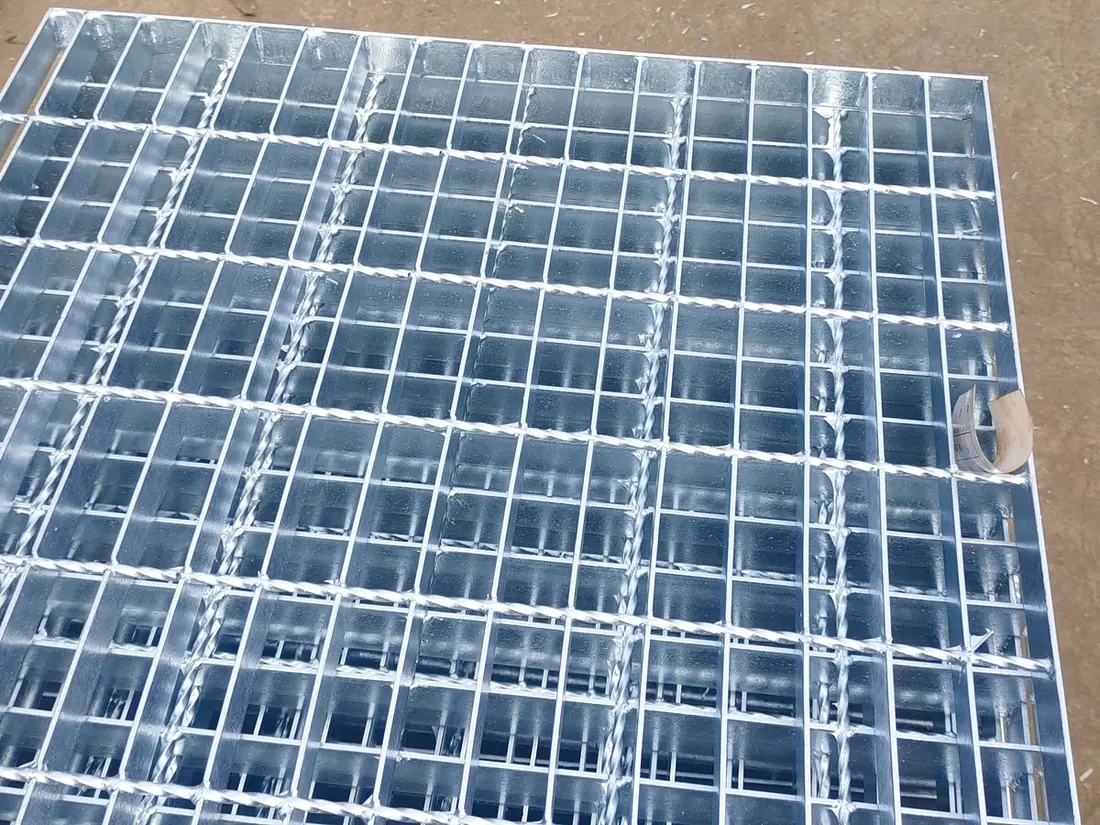
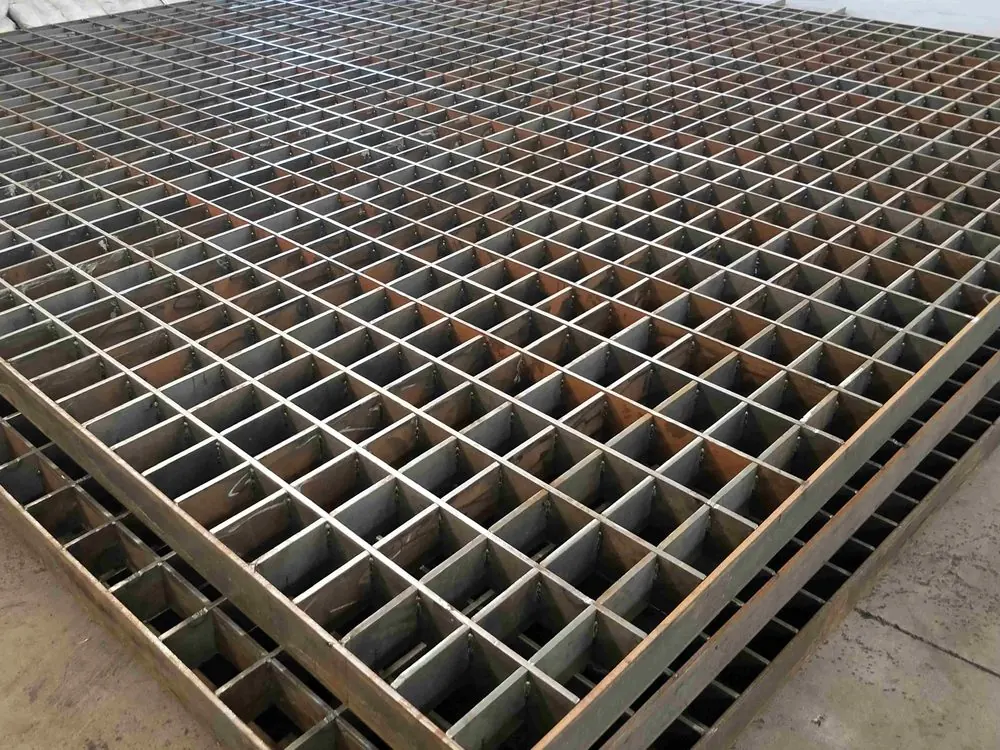
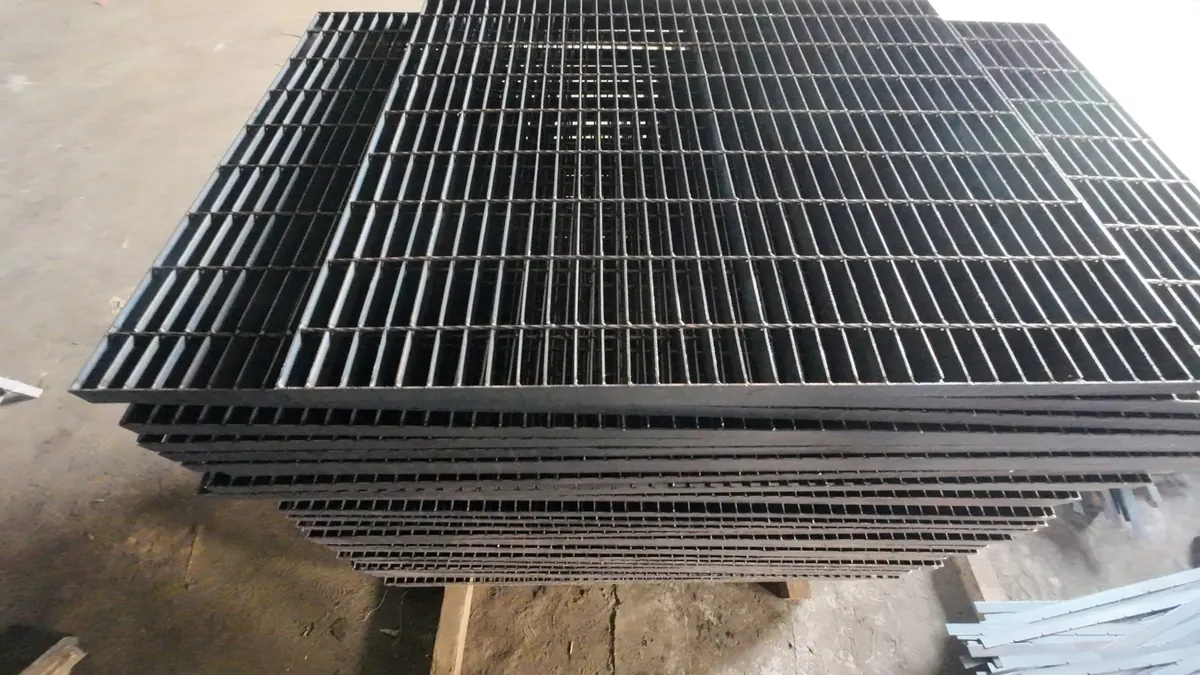
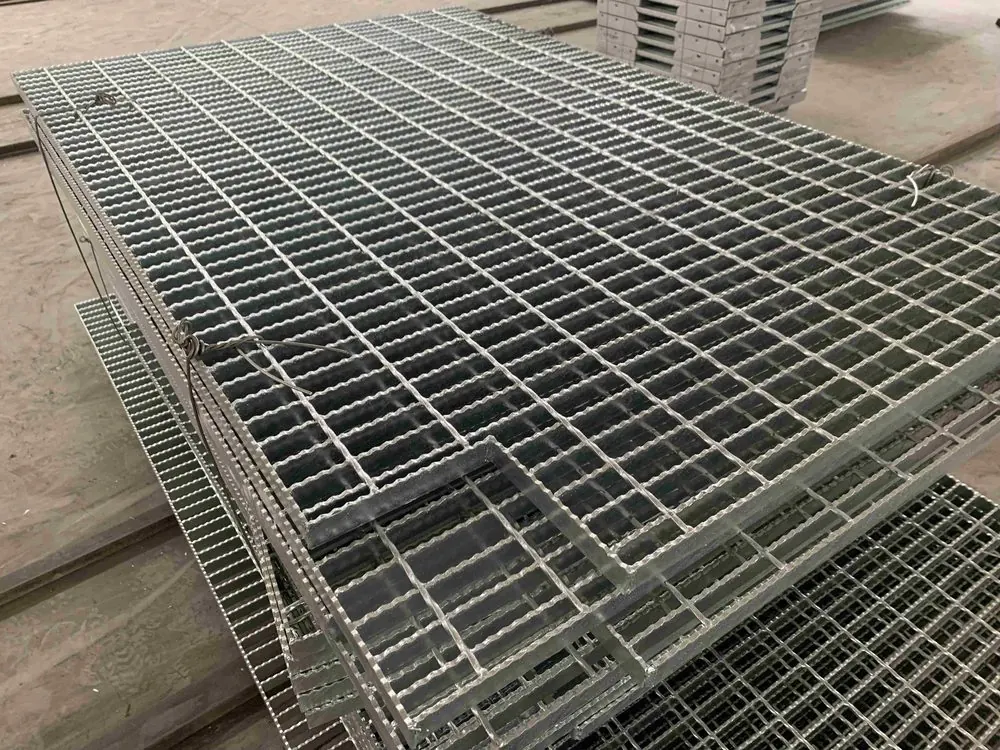
Anping factory press-locking line, edge banding and QC
Every Anping Hand in Hand steel grating panel is press-locked or welded, banded with continuous flat bar on all four edges, deflection-checked under uniform live load, and hot-dip galvanized to ASTM A123 / ISO 1461 before shipment. Buyers can request a project-specific point-load drop test as part of the SGS, BV or TUV third-party inspection at our factory.
How to size your steel grating in 5 steps – field-tested procurement workflow
Use this five-step decision tree the next time you raise an RFQ for an industrial walkway, drainage trench cover or heavy-duty mezzanine. Most procurement errors happen because step 1 (the actual service environment) is skipped or guessed. Skip it and you over-pay by 20-40% or, worse, install a panel that deflects out of tolerance.
- Document the service environment. Capture span (centre-to-centre of supports, mm), live load (kN/m² uniform or kN concentrated wheel/foot), deflection limit (L/200 industrial, L/300 architectural), atmosphere class (rural, urban, marine, chemical, food, offshore per ISO 9223), service life (10, 25, 50 years), and panel size (max ship dimension 6000 mm x 1000 mm or trench cover modular size).
- Pick bearing bar from the load lookup table above. Read down the span column; the first row that exceeds your design load is your minimum bar. Add one size up if the load is wheel point load not uniform, if there is vibration or impact, or if the panel will see chloride / acid attack (galvanic loss eats section over service life).
- Specify pitch, banding and surface finish. 30 mm bearing-bar pitch is the industrial default; heel-safe applications spec ≤ 30 mm (passes the 11 mm ball test). Continuous flat-bar banding on all 4 edges, same height x thickness as the bearing bar. Surface: hot-dip galv. ASTM A123 65-86 micrometre for outdoor; serrated bearing-bar top for slip-resistance on wet walkway; 304L / 316L stainless for chloride or food service.
- Issue the RFQ with one drawing and one parameter sheet. Drawing: panel layout, support locations, lifting lugs, edge banding direction. Parameter sheet: load case, deflection limit, finish, MTC requirement, third-party inspection (SGS / BV / TUV at factory before payment), packing (steel pallet + steel strapping for 6 m panel; wooden crate for < 2 m).
- Inspect and accept at factory. Demand EN 10204 type 3.1 MTC per heat (chemistry + tensile + yield + elongation), galvanizing thickness report (3-point min per ASTM E376), point-load drop test on one sample panel, container loading photos before B/L. Anping Hand in Hand sends all of this within 24 hours of the QC bay sign-off.
Common buyer mistakes to avoid
- Asking only for a “5 kN/m² grating”. Without span, deflection limit and atmosphere, no factory can quote responsibly. You will get the cheapest 25 x 3 that just hits 5 kN/m² at 0.6 m span – and your platform spans 1.2 m.
- Forgetting the cross-bar pitch. Bearing bar > 50 mm with 100 mm cross-bar pitch will twist under torsion. Spec 50 mm cross-bar pitch (twisted square) for offshore or heavy-vehicle service.
- Picking 304L when the service is chloride or sea spray. 304L pits within 1-3 years near salt water. Always 316L (PREN 24-27) for coastal, marine atmosphere or chloride spray, duplex 2205 (PREN 34-38) for splash zone, super duplex 2507 for immersion. See our 304 vs 316 vs 316L selection guide.
- Skipping the load-test drop on heavy-duty trench covers. EN 124 class D400 (40 kN wheel) covers must survive a 1.5x proof drop. Demand the drop-test report from your factory, signed by the QC engineer.
- Specifying galvanizing thickness instead of class. “65 micrometre min.” is project-specific; “ASTM A123 / ISO 1461 class > 6 mm steel” is the standardised call-out and accepts the natural 65-86 micrometre coating range.
Get a free steel grating sizing review from our senior application engineer
Send us your span, live load and deflection limit. He Zhanbing, our senior application engineer with 12+ years of bar-grating design experience, will reply within one business day with the recommended bearing bar, pitch, banding and surface finish – plus an Anping factory MTC sample for chemistry verification.
No obligation. Engineering review only.
About this guide and the author – why you can trust this load data
He Zhanbing
Senior Application Engineer
He Zhanbing, Senior Application Engineer at Anping Hand in Hand Wire Mesh Products Co., Ltd. (USCC 91131125MA7FT3EA0D), wrote and verified this guide on 2026-06-21.
Anping Hand in Hand is a source factory in Anping County, Hebei – China's largest wire mesh and steel grating production cluster. We supply hot-dip galvanized carbon steel grating (ASTM A1011, ASTM A123), 304L / 316L stainless steel grating and duplex 2205 / super duplex 2507 grating to industrial buyers across more than 25 countries. Our quality system runs to ISO 9001 with third-party verification by SGS, BV and TUV.
Standards cited in this guide: ANSI/NAAMM MBG 531-2019, ASTM A1011, ASTM A123, ASTM A580, EN ISO 1461, EN 1991-1-1, EN 124-2, OSHA 1910.28, GB 50009, GB/T 13912, AWS D1.1. Every shipment leaves the Anping factory with an EN 10204 type 3.1 MTC per heat and a project-specific load test report on request.
Frequently asked questions about steel grating load capacity
What is the load capacity of a 25 x 3 mm steel grating on a 1.0 m span?
Approximately 3.1 kN/m² uniform live load at L/200 deflection (carbon steel, sigma_allow = 165 MPa, bearing-bar pitch 30 mm, simply supported). For a typical pedestrian walkway designed at 2.5 kN/m² live load, 25 x 3 mm bearing bar at 1.0 m span is acceptable with a safety factor of 1.2x. For 5 kN/m² industrial platforms, jump up to 32 x 5 mm.
Why does steel grating load capacity drop so fast as span increases?
Two reasons. First, the bending moment under uniform live load grows with the square of the span (M is proportional to L²), so a 1.6 m span sees almost 7x the moment of a 0.6 m span at the same load. Second, deflection grows with the fourth power of span (delta is proportional to L^4), and most industrial walkways are limited by deflection, not strength. That is why doubling the span without changing the bar can cut allowable load by 8-16 times.
What deflection limit should I specify for my walkway or platform?
L/200 is the industrial default (ANSI/NAAMM MBG 531). L/300 is used for architectural and pedestrian-bridge walkways where vibration perception matters. L/150 is acceptable for purely service walkways without public access. Trench covers under wheel load follow EN 124 acceptance (residual deformation after proof load), not a simple deflection rule.
How do I size a steel grating panel for forklift point load?
Compute the moment M = P x L / 4 for a concentrated mid-span load P. Assume the load distributes across 2-3 bearing bars based on contact patch (200 mm x 200 mm spreads across 3 bars at 30 mm pitch; 100 mm x 100 mm wheel print across 2 bars). For a 20 kN forklift wheel on 1.0 m span across 3 bars: M = 20,000 x 1000 / 4 / 3 = 1,667,000 N*mm per bar. A 40 x 5 bar has Z = 1,333 mm³; sigma = 1,250 MPa – way overstressed. Use 50 x 8 or 60 x 6 instead, and verify with your structural engineer.
Does the bearing bar pitch matter for load capacity?
Yes – inversely. Halving the pitch (30 mm to 15 mm) doubles the number of bars per metre and doubles the per-square-metre capacity. Wider pitch (60 mm) cuts capacity in half. Most factory standard is 30 mm pitch; heel-safe walkways spec ≤ 30 mm to pass the 11 mm ball test (ANSI A1264.1, OSHA 1910.28). Wider pitches are used only on architectural facades and decorative panels where load is not a concern.
Can I use steel grating as a permanent floor in a forklift aisle?
Yes, but spec it correctly. Bearing bar 40 x 5 or larger, cross-bar pitch 50 mm (not 100 mm) to resist twist, twisted square cross bar for impact resistance, continuous welded banding on all 4 edges, lifting lugs welded to the banding. Many warehouse buyers go with checker-plate-top grating (steel grating welded to a 3 mm chequered plate cover) for forklift aisles – it spreads point load across many bars and avoids small-wheel jolt.
How does galvanizing affect load capacity?
Hot-dip galvanizing to ASTM A123 / ISO 1461 (65-86 micrometre Zn coating) does not change the structural section meaningfully – the coating is 0.07 mm on each face, well under the 3-10 mm bar thickness. The slight reduction in ductility from galvanizing has no practical effect on grating in bending. However, plain mild steel grating without galvanizing loses 0.05-0.1 mm section per year in industrial atmosphere, which over a 25-year service life can cut section by 5-10%. Always galvanize for outdoor or wet service.
What MTC and inspection documents should I demand from the factory?
EN 10204 type 3.1 MTC per heat (chemistry C, Si, Mn, P, S; mechanical yield, tensile, elongation), galvanizing thickness test per ASTM E376 (3-point min, 6-point average), AWS D1.1 weld inspection certificate, dimensional check report per MBG 531 Table II, and on heavy-duty panels a point-load drop test report. Third-party inspection at the Anping factory by SGS, BV or TUV is available before payment. Container loading photos are sent before the B/L is issued.
What is the typical lead time and packaging for Anping factory steel grating?
Standard hot-dip galvanized carbon steel grating: 15-25 days lead time from order confirmation, depending on panel quantity and project size. 304L / 316L stainless: 20-30 days. Duplex 2205: 30-45 days. Packaging: 6 m panels on steel pallets with steel strapping; < 2 m panels in wooden crates; trench covers in nailed timber crates with locking bar separately packed. Container loading: 20 GP holds 12-14 tons of 25 x 3 panels, 40 HQ holds 20-22 tons. FOB Tianjin or Qingdao port.